
N-400 vocabulary: the Part 9 questions explained
At the naturalization interview, the officer puts you under oath and goes through the answers on your Form N-400. Most of the questions people stumble over sit in one place, Part 9, "Additional Information About You". They use legal words that rarely come up in everyday English: habitual drunkard, totalitarian party, noncombatant service, expunged. This guide explains what each one means, using the wording of the form itself and of the USCIS guidance behind it.
Which edition this guide follows
USCIS lists the current edition of Form N-400 on its form page as 01/20/25, and the date is printed at the bottom of each of the 14 pages. The same page warns that if you mail a paper form, every page must come from the same edition. The question numbers below are the ones on that edition and on its instructions. The previous 09/17/19 edition put these questions in Part 12 with different numbers, so a guide written for that edition will not match your form.
The instructions explain why Part 9 exists: the answers help USCIS decide whether you meet the standard of good moral character, and some of them relate to national security and to your attachment to the principles of the Constitution. Good moral character is measured over a set period before you file, generally 5 years, or 3 if you apply as the spouse of a U.S. citizen, and it continues until you take the Oath of Allegiance.
"EVER"
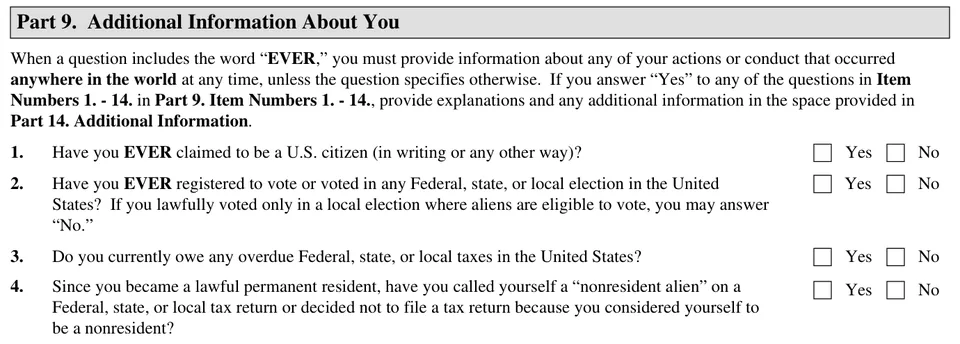
The capital letters are deliberate. Part 9 opens with a rule for every question that contains the word: you must give information about your actions or conduct anywhere in the world, at any time, unless the question itself sets a limit. "Have you EVER" reaches back before your green card, before you came to the United States, and into your childhood. Questions without the word, such as question 3 about taxes you owe now, ask about the present.
"Claimed to be a U.S. citizen (in writing or any other way)" (question 1)
This is the first question in Part 9, and the parenthesis matters. The USCIS Policy Manual (Volume 12, Part F, Chapter 5) says a false claim can be made in an interview, on a written or online application, or by handing over evidence. Whether the claim was made under oath is irrelevant, and it can be made to any federal, state or local official or even to a private person, and the Manual gives an employer as the example.
The case the Manual describes in most detail is voter registration. Many states put a voter registration section inside the driver's license or state ID application, and that section usually asks whether you are a U.S. citizen. USCIS treats answering "yes" to that question in order to register as a false claim to citizenship, and the Manual says this can apply even when the registration was done together with the license application.
The Manual also describes a narrow exception that Congress added in 2000. It covers someone whose parents were both U.S. citizens at the time, who lived permanently in the United States before age 16, and who reasonably believed they were a citizen when they made the claim. All three conditions have to be met, and the exception is not available to someone convicted of the related federal voting or citizenship-claim crimes when the conviction became final on or after October 30, 2000.
"Registered to vote or voted" (question 2)
The question covers federal, state and local elections, and it asks about registering as well as voting. The form adds one way out: if you lawfully voted only in a local election where noncitizens are allowed to vote, you may answer "No". The instructions repeat the point, saying a vote in a local election does not make you ineligible if you were eligible to vote under the law that applied.
The Policy Manual explains that it is a federal crime for a noncitizen to vote in a federal election. When the record shows a registration or a vote, the officer may ask for the voter registration card, the registration form and the voting record from the board of elections. The Manual also mentions evidence that someone who realized the mistake asked to be removed from the voter list.
"Overdue taxes" and "nonresident alien" (questions 3 and 4)
Question 3 asks whether you owe any overdue federal, state or local taxes right now. Question 4 is about something narrower: whether, since you became a permanent resident, you called yourself a "nonresident alien" on a tax return, or skipped filing because you considered yourself a nonresident. Nonresident alien is a term from tax law, which is why the question is about tax returns. The instructions say a failure to pay taxes as required may lead USCIS to find a lack of good moral character, and they send you to the IRS to check whether you had to file.
If you do owe taxes, the instructions list what to bring: IRS tax transcripts for the past 5 years (3 if you apply on the basis of marriage to a U.S. citizen), a signed agreement with the tax office showing you filed and arranged to pay, and proof of where the repayment plan stands. Tax transcripts are not required in every case.
"Communist or totalitarian party" and "world communism" (questions 5.a and 5.b)
Question 5.a asks whether you were ever a member of, involved in or associated with a Communist or totalitarian party anywhere in the world. Question 5.b lists ideas a group might have advocated, from "opposition to all organized government" to sabotage, and asks whether you supported them or belonged to such a group. The instructions define "world communism" as a revolutionary movement aiming to set up a Communist totalitarian dictatorship in any or all countries through an internationally coordinated Communist movement.
The Policy Manual (Volume 12, Part D, Chapter 7) bars naturalization when the membership falls within the 10 years before filing and up to the oath, and it lists exemptions: membership that was involuntary, that happened without knowing what the organization was or wanted and stopped once you found out, that ended before age 16, that ended more than 10 years before filing, that came by operation of law, or that was necessary to get a job, food rations or other essentials of living. The burden of showing an exemption is on the applicant, and the Manual says membership only to get a college education generally does not qualify.
Armed groups, "paramilitary" and "vigilante" (questions 6 to 14)
This block is long and the words are heavy, but the form defines most of them in parentheses. An armed group is "a group that carries weapons". A paramilitary unit is "a group of people who act like a military group but are not part of the official military", and the form names self-defense units, vigilante units, rebel groups and guerrilla groups as other examples. "Conspired" is glossed as "planned with others" and "incited" as "encouraged".
Some of these questions reach ordinary service. Question 8.a asks whether you ever served in, belonged to, helped or took part in any military or police unit, with no qualification. If you answer "Yes" to 8.a or 8.b, the form asks for the country, the name of the unit, your rank or position and your dates of involvement. Question 12 asks about any weapons training, paramilitary training or other military-type training. Question 9 covers working, volunteering or serving anywhere people were detained, and lists a prison, jail, prison camp, detention facility and labor camp. Questions 13 and 14 ask about involving anyone under 15 in an armed group or in hostilities.
"Arrested, cited, detained, or confined" and "sealed, expunged" (questions 15 and 16)
Question 15 has two halves. 15.a asks about any crime or offense you committed, agreed to commit or tried to commit and were not arrested for. 15.b asks whether you were ever arrested, cited, detained or confined by a law enforcement officer, a military official or an immigration official, for any reason, in the United States or elsewhere, or charged with a crime or offense.
The form is blunt about cleared records. You list each offense even if the record was sealed, expunged or otherwise cleared, and even if a judge, a police officer or a lawyer told you it is no longer on your record or that you do not have to mention it. The instructions add offenses from before age 18, domestic violence and driving under the influence, and warn that leaving something out can lead to a denial even when the original offense would not have.
The Policy Manual explains the reason. Expunging a record does not remove the underlying conviction for immigration purposes. The Manual also says a juvenile court judgment generally does not count as a conviction, that a pretrial diversion program with no admission or finding of guilt may not count either, and that an officer cannot approve an application while you are on probation, on parole or under a suspended sentence. That last point is what question 16 is checking.
For traffic incidents, the instructions say you only need to bring documents if the incident involved alcohol or drugs, led to an arrest or seriously injured someone.
"Habitual drunkard"
The current form does not use this phrase. The 09/17/19 edition asked it as a separate question, "Been a habitual drunkard?", number 30 in Part 12 (a copy of that edition survives in the Internet Archive). The 01/20/25 edition has no question with those words, which is why older study lists still mention it and your form does not.
The rule behind it is still in force. The Policy Manual lists being or having been a habitual drunkard during the period of good moral character among the conditional bars, citing section 101(f)(1) of the Immigration and Nationality Act. It does not define the term with a number of drinks. It lists signs an officer may look at: divorce decrees, employment records and arrest records, losing a job, unexplained periods of unemployment, and arrests or several convictions for public intoxication or driving under the influence.
Driving under the influence has its own rule in the same chapter. Two or more DUI convictions during the period create a presumption that you lack good moral character, and the Manual says you can try to overcome it with substantial, credible evidence that the convictions were an aberration.
The list in question 17
Question 17 groups eight "Have you EVER" items, and several use older legal wording. 17.a asks about engaging in prostitution, trying to "procure or import" prostitutes, or receiving money from prostitution; the Policy Manual notes that a single act of soliciting prostitution for yourself is not the same as procuring. 17.b covers making, growing, selling or smuggling controlled substances, illegal drugs or drug paraphernalia. "Married to more than one person at the same time" in 17.c lines up with the Policy Manual's bar on polygamy, which it defines as "the custom of having more than one spouse at the same time". The Manual adds that bigamy, marrying someone while still legally married to someone else, is a different thing that may be weighed under another rule. 17.d asks whether you married to get an immigration benefit.
In 17.g the form defines alimony itself: "court-ordered financial support after divorce or separation". The Policy Manual says a willful failure to support your dependents during the period bars good moral character unless you show extenuating circumstances, that support owed abroad can count, and that courts have treated parents as obligated to support their minor children even without a court order. 17.h asks about any misrepresentation made to get a public benefit.
"Removal, rescission, or deportation proceedings" (questions 20 and 21)
Question 20 asks whether you were ever placed in removal, rescission or deportation proceedings. Question 21 is a separate question and asks whether you were in fact removed or deported. A "Yes" to either one needs an explanation in Part 14, and for a removal the instructions ask for your name, the port of entry you left from and the reason.
"Selective Service" (question 22)
Right above question 22, the form explains who has to register with the Selective Service System: nearly all people born male, citizens and immigrants alike, from 18 through 25 years of age. The Selective Service says the same. Question 22.a asks whether you are a male who lived in the United States at any time between your 18th and 26th birthdays, and tells you not to answer "Yes" if you were a lawful nonimmigrant for the whole time.
If you were required to register and did not, the instructions sort applicants by age. Under 26, you must register before you apply. After 26 and before 31 (29 if you apply as the spouse of a U.S. citizen), you explain in Part 14 why you did not register and include a status information letter from the Selective Service. At 31 or older (29 for spouses), the instructions say you need neither. The Policy Manual adds that what counts is a failure that was knowing and willful, and that you can show it was not. You can check an existing registration on the Selective Service website.
Draft, exemptions and desertion (questions 23 to 29)
Question 24 asks whether you ever applied for any kind of exemption from service in the U.S. armed forces, and question 28 whether you were discharged because you were not a citizen. The instructions explain why: if you received an exemption or discharge because you lacked lawful status to serve, you may not be eligible. On question 29, desertion, a wartime desertion conviction rules out naturalization, and the Policy Manual says someone who admits a wartime desertion but was never convicted of it may still be eligible.
"Hereditary title or an order of nobility" (question 30)
The instructions point out that most people do not have a foreign hereditary title or order of nobility. If you do have one, the law requires you to give it up at your naturalization ceremony, and question 30.b asks whether you are willing to.
"Bear arms", "noncombatant services" and "work of national importance" (questions 31 to 37)
The last questions of Part 9 follow the words of the Oath of Allegiance, and the form glosses each one. To bear arms is to "carry weapons" on behalf of the United States. To perform noncombatant services in the armed forces is to "do something that does not include fighting in a war". Work of national importance under civilian direction means to "do non-military work that the U.S. Government says is important to the country". Each of those three questions begins "If the law requires it".
A "No" to one of these questions sends you to the Oath of Allegiance section of the instructions. That section and the Policy Manual (Volume 12, Part J, Chapter 3) describe three variations of the oath:
- A modified oath without the clauses on bearing arms, noncombatant service or both, for religious training and belief or a deeply held moral or ethical code. You do not have to belong to a church, but an objection to one particular war does not qualify. No modification is available for the clause on civilian work.
- An affirmation, which replaces "on oath" with "solemnly affirm" and leaves out "so help me God". You can ask for it for any reason, with no documents.
- A waiver of the oath for someone who cannot understand or communicate its meaning because of a physical or developmental disability or a mental impairment. Question 33 is where you indicate this.
Changing an answer at the interview
Your written answers are signed under penalty of perjury, and the Policy Manual chapter on the naturalization examination describes what happens to them. The officer reviews each response, asks follow-up questions and may take a sworn statement. The written record includes any amendments the officer makes during the interview as a result of what you say. Knowing what each full question covers makes it easier to explain an answer, or to correct one, when the officer reaches it.
Where to go from here
The interview guide walks through the rest of the appointment, including the civics test, and the practice test lets you rehearse it. For a question about your own record, the USCIS Contact Center can look up your case, and USCIS keeps a page on finding legal help from attorneys and accredited representatives.
Keep reading
- The civics test in your naturalization interview
- A study plan for the 128 civics questions
- The 65/20 special consideration
- English test exemptions: 50/20, 55/15 and Form N-648
- Civics test answers that change with elections
- How the naturalization test is scored
- The November election and your civics test answers
- 2008 vs 2025 civics test: which one you take